

back
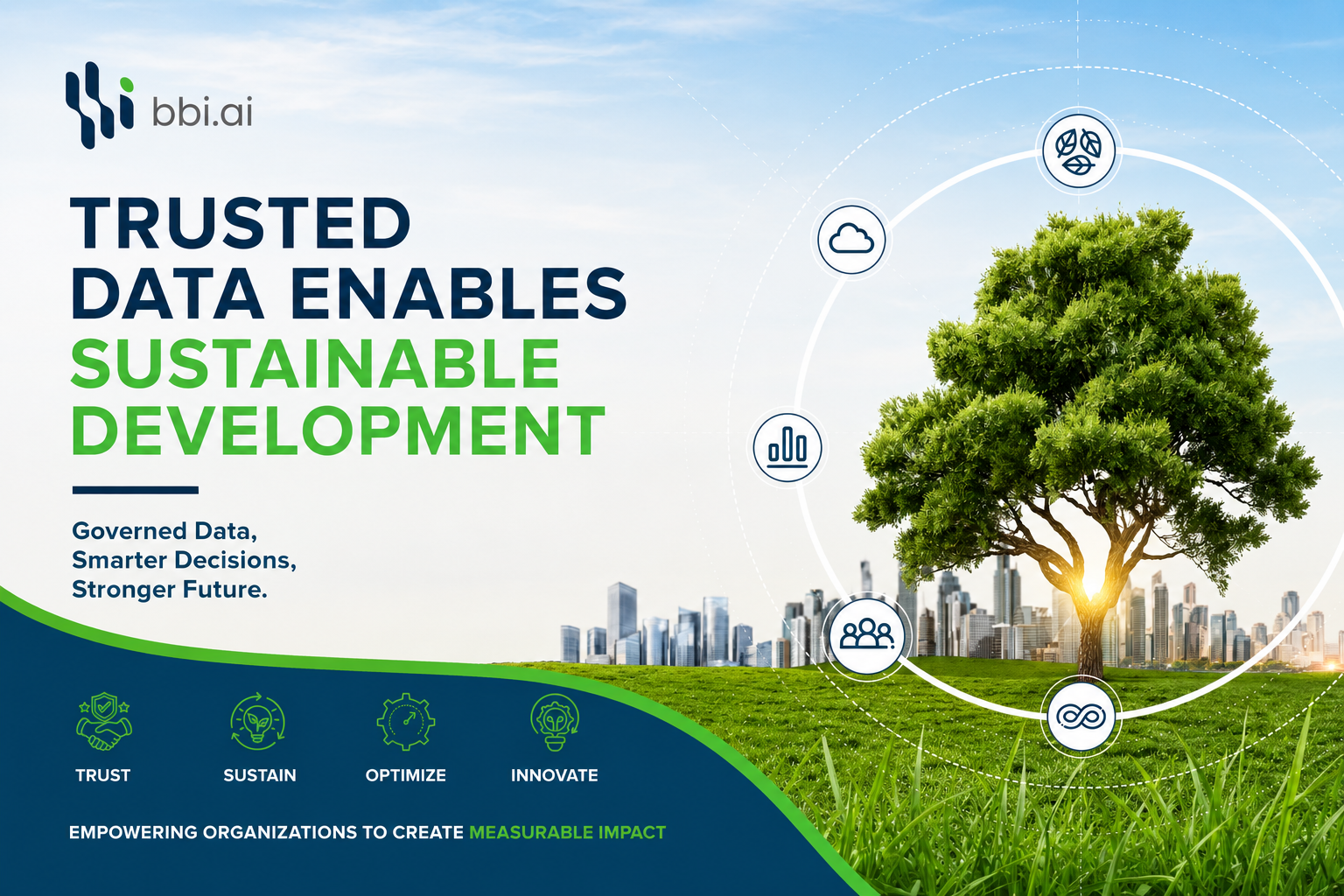
Trusted Data enables Sustainable Development: Empowering Organizations to Measure, Optimize, and Transform
Sustainability and Digital Transformation are no longer separate conversations
A few years ago, sustainability was often viewed as a corporate responsibility initiative, something organizations discussed in annual reports or highlighted in marketing campaigns. Today, the conversation has changed dramatically.
Organizations across the globe are facing growing pressure from regulators, investors, customers, and society to demonstrate measurable progress toward sustainability goals. Whether it’s reducing carbon emissions, improving resource efficiency, strengthening ESG reporting, or supporting national sustainability agendas, organizations are expected to deliver real results.
At the same time, businesses are accelerating their digital transformation efforts. Artificial Intelligence (AI), cloud computing, analytics, automation, and connected technologies are becoming critical tools for improving performance and driving innovation.
What many organizations are beginning to realize is that these are not two separate journeys.
Sustainability and digital transformation are becoming deeply interconnected. In fact, one cannot succeed without the other.
The technologies that help organizations become more sustainable depend on accurate, reliable, and accessible data. And without trusted data, sustainability becomes difficult to measure, manage, and improve.
Technology is accelerating Sustainable Development
Technology has become one of the most powerful enablers of sustainable development.
Across industries, organizations are using digital capabilities to optimize operations, reduce waste, improve efficiency, and make better decisions.
Smart sensors can monitor energy consumption in real time. AI algorithms can identify inefficiencies in manufacturing processes. Advanced analytics can help organizations understand emissions patterns and predict future resource needs. Cloud platforms can reduce the environmental footprint of traditional IT infrastructure while providing the scalability needed to support innovation.
The impact extends beyond individual organizations.
Cities are becoming smarter through intelligent transportation systems. Renewable energy providers are using AI to forecast energy demand and optimize production. Supply chains are becoming more transparent through digital tracking technologies. Even water management systems are leveraging real-time data to improve conservation efforts.
These innovations are helping organizations balance business growth with environmental responsibility.
But technology itself is not the answer.
Technology is simply the enabler.
The real value comes from the information that powers it.
The missing link in many sustainability initiatives
Despite significant investments in technology, many sustainability initiatives struggle to deliver their full potential.
The problem is rarely a lack of ambition.
Most organizations genuinely want to improve sustainability performance. They invest in reporting tools, dashboards, monitoring systems, and analytics platforms. Yet many still struggle to answer some very basic questions:
- What are our actual carbon emissions?
- Which operations consume the most energy?
- Where are the biggest opportunities for improvement?
- Which sustainability initiatives are delivering measurable value?
- How can AI help us make more sustainable decisions?
The answer often lies in the quality of the underlying data.
Consider a sustainability leader preparing an ESG report.
Data needs to be collected from multiple sources across the organization. Information may come from operational systems, financial applications, supply chain partners, energy monitoring platforms, and spreadsheets maintained by different teams.
Everyone has data.
But very few organizations have a complete and trusted view of it.
As a result, teams spend valuable time validating numbers, reconciling inconsistencies, and chasing missing information instead of focusing on initiatives that create meaningful impact.
Without trusted data, sustainability becomes an exercise in estimation rather than decision-making.
Why trusted data matters more than ever
As sustainability requirements continue to evolve, organizations are being asked to provide greater transparency and accountability.
Investors want evidence.
Regulators expect compliance.
Boards want confidence in the information used to guide strategic decisions.
Customers increasingly prefer organizations that can demonstrate measurable progress toward sustainability commitments.
This means organizations can no longer rely on fragmented systems, manual processes, or disconnected reports.
They need data they can trust.
Trusted data provides the visibility needed to understand current performance, identify opportunities for improvement, and measure progress over time.
More importantly, it creates confidence in decision-making.
When leaders trust their data, they can move faster, invest more effectively, and respond to challenges with greater certainty.
This is where the relationship between sustainability and data management becomes critically important.
Building the foundation for Sustainable Intelligence
Successful sustainability programs are built on strong data foundations.
The first step is establishing clear governance.
Organizations need to define ownership, accountability, policies, and standards for the information that supports sustainability reporting and decision-making. Without governance, data quickly becomes inconsistent and difficult to trust.
The second step is improving data quality.
Even the most advanced AI models and analytics platforms cannot compensate for inaccurate or incomplete information. Organizations must ensure that sustainability-related data is accurate, consistent, and reliable across systems and departments.
The third step is integration.
Sustainability data often exists across multiple business functions. Bringing these sources together into a unified environment creates a single source of truth that supports reporting, analytics, and operational decision-making.
Finally, organizations must leverage analytics and AI to transform data into insights.
Once trusted data foundations are established, organizations can move beyond reporting and begin identifying opportunities for optimization, innovation, and long-term value creation.
Moving beyond measurement
One of the most common misconceptions about sustainability is that reporting alone creates progress.
Measurement is important.
But measurement is only the beginning.
The organizations creating the greatest impact are those using data to drive action.
The journey often starts with visibility. Organizations establish baselines, understand their current performance, and identify gaps.
The next stage focuses on optimization. Data and analytics help reduce waste, improve efficiency, and streamline operations.
The final stage is transformation.
This is where organizations fundamentally rethink processes, business models, and decision-making approaches to create sustainable long-term growth.
Technology enables this transformation.
Trusted data makes it possible.
Organizations that successfully move through these stages are no longer treating sustainability as a compliance requirement. They are using it as a competitive advantage.
The growing role of AI in sustainability
Artificial Intelligence is rapidly becoming one of the most valuable tools available to sustainability leaders.
AI has the ability to process vast amounts of information, identify patterns, and generate insights that would be difficult, or impossible to uncover manually.
In manufacturing environments, AI can optimize production schedules to reduce energy consumption.
In logistics operations, intelligent algorithms can identify more efficient transportation routes, reducing fuel usage and emissions.
In facilities management, AI can continuously monitor building performance and automatically adjust energy usage based on occupancy and operational requirements.
AI can also help organizations forecast future sustainability scenarios, assess risks, and evaluate the potential impact of strategic decisions.
However, there is an important reality that organizations must acknowledge:
AI is only as effective as the data behind it.
Poor-quality data leads to poor-quality insights.
This is why organizations looking to scale AI initiatives must first invest in governance, quality, and trusted data foundations.
BBI helps organizations turn sustainability ambitions into measurable outcomes
At BBI, we have seen firsthand that the biggest challenge facing many organizations is not a lack of technology.
It is a lack of trust in the data that supports decision-making.
Organizations often know where they want to go. They have sustainability goals, ESG commitments, and transformation strategies.
What they need is the foundation that enables them to measure progress and act with confidence.
Through our expertise in Data Governance, Data Management, Modern Data Platforms, Analytics, and Artificial Intelligence, we help organizations establish that foundation.
By improving data quality, defining ownership models, integrating critical information assets, and enabling advanced analytics capabilities, we help organizations transform data into a strategic asset.
This allows leaders to move beyond reporting and create measurable business and sustainability outcomes.
Conclusion
The future of sustainable development will not be determined by technology alone.
It will be determined by how effectively organizations use technology to make better decisions.
Those decisions depend on data.
As sustainability and digital transformation continue to converge, organizations must invest in the capabilities that enable both. Strong governance, reliable information, advanced analytics, and AI are no longer optional, they are essential components of a sustainable business strategy.
The organizations that succeed in the coming decade will be those that recognize sustainability as both a business challenge and a data challenge.
Because sustainability is ultimately about making better decisions.
And better decisions start with trusted data.